by Srđan Miljević translation into English by Svetlana Milivojević-Petrović
*Scroll down to read the story in Serbian*
Superglue
‘Milica!!! Come over here fast, please! I’m fucked up! I need to be fixed. Hurry up, pleeeeease!’
‘Oh, OK. Ivan and I’ll get a taxi now. Don’t move.’
‘Hey, I love you!’
‘Love you too, you fool, don’t move. We’re coming.’
*
‘Fuck, he can do this every single day. Why the fuck does he have to do it? What are we going to do? There’s no point in rushing like this and trying to save him each time he gets into a dark mood’, Ivan said, looking out of the taxi window.
‘Hey, please, let’s leave this for later. It pisses me off when you are acting smart while there’s a fire burning. We’ll be moralizing tomorrow. Cool it. Do you think I haven’t had enough of this? That I haven’t felt the impulse to hang up on him at least three times and ignore him? And yet, I can understand him. I don’t know…’
‘Fuck, it’s just… Do you think he’d have the guts to do himself in?’
‘Yes, turn right here and then take the second turning on the left. We’ll get out there and you’ll wait for us for a minute, and then we’ll go to the Emergency Department. Thank you’, Milica said to the taxi driver.
The spring
evening in Belgrade was unusually hot, so the sweat stinking from the driver
made the rescue mission even more dramatic.
‘I
think he would. It makes no difference whether you’ll cut your leg off and call
Milica or just cut your leg off and not call Milica. Does it?’, she added after
talking to the taxi driver.
‘But
he always calls Milica’, protested Ivan.
‘So
far he has.’
*
The
way they entered Jasmin’s apartment looked like an ambulance crew taking
action. Milica and Ivan were so well-practiced there was no need for
instructions. They lifted Jasmin, then Ivan carried him piggyback out of the
apartment. Milica waded through the rubbish on the floor to the kitchen stove
and turned off the burner. She swiftly turned off several other appliances that
were turned on, picking up Jasmin’s leg from the floor in passing, that is the
part of his left leg below the knee. She switched off the light and left the
apartment.
*
In the ER, in the room Jasmin called the fix[1], there were body parts lying strewn around. Jasmin was sitting on the bench outside room 22, with the sign LNGH!7, which meant he was an emergency case and they were going to see him soon. Ivan looked around with curiosity, and the twinkle in his eyes confirmed what Milica already knew. He was amused by this. And all she wanted was to stay put in her crib tonight. To watch with Ivan that documentary about India in which, with the help of 6D glasses, you can feel the mud on your feet, the scent of an orchid stick getting into your nostrils, while Buddha himself is hugging you all the time.
The
digital display on the screen changed, and it was Jasmin’s turn. He walked in
by himself, out of habit. Milica was sitting, lost in her thoughts, while Ivan
went on playing a mental game in his head in which he would attach legs, arms,
ears and eyes, previously separated from their original owners, to mismatched
owners. So the old man sitting opposite him, leaning his arm on the wall, ended
up with a small turned-up nose that belonged to a girl on the other side of the
corridor.
*
‘Jasmin,
it’s you again.’
‘Again.’
‘Ok.
Let’s put everything back in its place straight away.’
‘If
necessary’, Jasmin said jokingly.
The
doctor gave him a civil smile and then said to the technician:
‘Elena,
please, the glue and fast sterilization of this leg. Well, Jasmin, is this your
fourth or fifth time?’
‘The
fifth time, Doc.’
‘You
already know everything. The state only covers…’
‘I
do, yes, Doc”, Jasmin interrupted him. “But I don’t want to kill myself.’
‘You
said it last time. And the time before. And…’
‘Well,
I didn’t want it then, either. I’ve already told you…’
‘Remember,
next time we won’t be able to receive you or react’, the doctor said, applying
glue below the knee with one hand, and on the free part of the leg with the
other.
‘Agreed,
Doc. Don’t worry. I say, it’s fascinating to me how you glue it for me so well
each time that there’s no mark. And how everything functions properly.’
‘And
this is why you’re playing with your fate and cutting yourself to see if the
leg will be glued properly next time as well?’
‘You
are quite a joker, Doc.’
‘Jasmin,
please install the application My
psychologist. Try it.’
‘Si,
señor’, said Jasmin smiling at Elena, who was already getting ready for the
next patient.
*
‘I feel brand new”, he exclaimed after leaving room 22 walking on both legs.
The doctor patted him on the shoulder and said to Milica:
‘You
know that he can only take fluids today. From tomorrow, he’ll be functioning as
if nothing had happened. Take care of him. We have agreed on the application.
This has been his fifth time”.
‘I
know doctor. Don’t worry. The three of us will be out all day tomorrow, that is
sure to raise his spirits. Thanks a lot.’
‘Take
care. And don’t forget that such procedures were almost impossible until
recently. Jasmin, there won’t be glue forever. Goodbye.’
‘See
you, Doc.’
*
The
next day they enjoyed the spring sun.
He
was alright.
They
laughed, ran and had a short swim in the lake.
After
three days Milica’s phone rang in the evening.
It was Jasmin.
[1] Abbreviation for Odeljenje za fizikalno ikoštano spajanje (the Department for Physical and Bone Attachments). Fiks = fix. Translator’s note
Srđan Miljević is a short story writer from Belgrade, Serbia. His main topic is people facing different challenges and trying to overcome them. He does not write about progress, but about process.
***
Superlepak
„Milice!!! Brzo dođi kod mene, brzo, molim te! Sjebao sam se! Moram na fiks. Požuri, pleeeeeaaaaaaaseeeeee!”
„Joj,
ajde. Sad ćemo Ivan i ja na taksi. Ne pomeraj se.”
„Ej,
ljubim te”.
„I ja
tebe, budalo, ne pomeraj se. Stižemo”.
*
„Jebote, on može tako svaki dan. Koji
kurac više! Šta da radimo? Nije rešenje da ovako trčimo i spasavamo ga čim mu
se smrači”, govorio je Ivan, gledajući kroz prozor taksija.
„Aj please da to ostavimo za posle. Smara me
kad pametuješ dok gori. Sutra ćemo da morališemo. Iskuliraj. Misliš da meni
nije muka više? Da mi bar triput nije došlo da mu spustim slušalicu i da ga
iskuliram? A opet, mogu da ga razumem. Otkud znam…”
„Jebi
ga, samo… Misliš da bi imao muda da se rokne?”
„E,
da, skrenite tu desno i onda druga levo. Tu ćemo izaći a vi nas sačekajte koji
minut, pa idemo u urgentni. Hvala vam”, rekla je Milica taksisti.
Prolećno
beogradsko veče bilo je neuobičajeno toplo, pa je vonj znoja vozača ovu
spasilačku misiju činio dramatičnijom.
„Mislim
da bi. Isto je da l’ ćeš da otfikariš sebi nogu i nazoveš Milicu ili ćeš je
samo otfikariti i nećeš nazvati Milicu. Zar ne?”, dodala je ona nakon obraćanja
taksisti.
„Ali
on uvek zove Milicu!”, bunio se Ivan.
„Dosad
je zvao.”
*
Ulazak
u Jasminov stan izgledao je kao akcija
službe hitne pomoći. Milica i Ivan bili su toliko uigrani da nije bilo potrebe
za instrukcijama. Podigli su Jasmina, onda ga je Ivan stavio na krkače i izneo napolje. Milica je kroz krš na podu otišla do šporeta i
isključila ringlu. Brzinski je protrčala i pogasila još nekoliko uključenih
aparata, uzimajući u prolazu Jasminovu nogu s poda, tj. deo leve noge do ispod
kolena. S nogom pod miškom ugasila je svetlo i izašla iz stana.
*
U urgentnom, u ambulanti koju je Jasmin zvao fiks[1], svuda su bili razbacani delovi tela. Jasmin je sedeo na klupi ispred sobe 22, s oznakom LNGH!7, što je značilo da je hitan slučaj i da će ga uskoro primiti. Ivan je radoznalo gledao oko sebe, a iskre u očima potvrđivale su ono što je Milica znala. Ovo ga je zabavljalo. A ona je samo želela da večeras ne mrda nigde s gajbe. Da Ivan i ona pogledaju taj dokumentarac o Indiji, gde uz pomoć 6D naočara na stopalima osetiš blato, u nos ti ulazi miris štapića orhideje, a sve vreme te grli Buda lično.
Displej
se promenio i sada je bio Jasminov red. Ušao je sam, po navici. Milica je
sedela zamišljena, a Ivan nastavio da se igra tako što je u svojoj glavi noge,
ruke, uši i oči koje su bile odvojene od svojih vlasnika spajao s pogrešnim
vlasnicima. Tako je dedi preko puta, čija je ruka bila naslonjena na zid,
stavio mali prćasti nos devojke s one strane hodnika.
*
„Opet ti, Jasmine.”
„Opet.”
„Dobro. Hajde da odmah vratimo sve na svoje mesto.”
„Ako baš mora”, šeretski odgovori Jasmin.
Doktor se kurtoazno nasmešio, a onda se obratio tehničarki:
„Elena,
molim vas lepak i brzu sterilizaciju ove noge. Pa, Jasmine, je l’ ovo četvrti
ili peti?“
„Peti
put, doco”.
„Sve
već znaš. Država pokriva samo…”
„Znam,
znam, doco”, prekinuo ga je Jasmin u pola rečenice. ”Ali, ja neću da se
ubijem.”
„To
si rekao i prošli put. I pre toga. I…”
„Pa,
ni tada nisam hteo. Rekao sam vam već… “
„Zapamti,
sledeći put nećemo moći da te primimo, a ni reagujemo”, rekao je doktor sad već
nanoseći lepak na potkolenicu jednom, a na slobodni deo noge drugom rukom.
„Dogovoreno,
doco. Ništa ne brinite. Mislim, meni je fascinantno kako mi je svaki put lepo
zalepite da se baš ništa ne vidi. I da baš sve radi kako treba.”
„Pa
se igraš sudbinom i seckaš se ne bi li video hoće li i naredni put biti dobro
zalepljena, a?”
„Vi
ste, doco, baš neki šaljivdžija.”
„Jasmine,
molim te da ipak instaliraš aplikaciju Moj
psiholog. Probaj.”
„Si,
senjor”, rekao je Jasmin smeškajući se Eleni koja se već pripremala za sledećeg
pacijenta.
*
„Ko
nov”, uskliknuo je po izlasku iz sobe 22 hodajući na obe noge.
Doktor
ga je potapšao po ramenu i obratio se Milici:
„Znate
da danas sme da unosi samo tečnost. Od sutra će funkcionisati kao da se ništa
nije desilo. Pripazite ga. Dogovorili smo se za aplikaciju. Već mu je peti
put”.
„Znam,
doktore. Ne brinite. Sutra ćemo nas troje ceo dan biti napolju, to će ga
sigurno odobrovoljiti. Hvala vam mnogo.”
„Čuvajte
se. I ne zaboravite da su ovakvi zahvati do skoro bili nemogući. Jasmine, lepka
neće biti zauvek. Doviđenja”.
„Vidimo
se, doco”.
*
Sutradan su uživali u prolećnom suncu.
Bio
je dobro.
Smejali
su se, trčali i kratko se okupali u jezeru.
Nakon
tri dana Milici je uveče zazvonio telefon.
Bio
je to Jasmin.
[1] skraćeno od Odeljenje zafizikalno i koštano spajanje
Srđan Miljević (Beograd, Srbija) piše kratke priče o ljudima koji se suočavaju s različitim izazovima i pokušajima da ih prevaziđu. Srđan ne piše o progresu, već o procesu.
In
a recent New York Timesop-ed, Aaron
Bastani, author of Fully Automated Luxury Communism, called
refusals to adapt capitalist technologies under anti-capitalism’s banner a
failure of imagination:
“Ours is an age of crisis. We inhabit a world of low growth, low productivity and low wages, of climate breakdown and the collapse of democratic politics. A world where billions, mostly in the global south, live in poverty. A world defined by inequality.
But the most pressing crisis of all, arguably, is an absence of collective imagination. It is as if humanity has been afflicted by a psychological complex, in which we believe the present world is stronger than our capacity to remake it—as if it were not our ancestors who created what stands before us now. As if the very essence of humanity, if there is such a thing, is not to constantly build new worlds.
If we can move beyond such a failure, we will be able to see something wonderful. The plummeting cost of information and advances in technology are providing the ground for a collective future of freedom and luxury for all.“
There
is much to unpack here, part and parcel of a futurism more social democratic
than communist already critically reviewed here,here, and here.
Are
democratic politics even possible under capitalism, as Bastani
off-handedly presumes? Is high growth an appropriate economic
marker even out of capitalist hands? And what of the apparent disconnect here between
all the new toys Bastani stans and that poverty in the global South?
I’ll
be confining my objections here to the analytical core of Bastani’s thesis,
before briefly turning to what a science (and tech) for the people, tied to a
truly transformative shift in human relations, is already looking like instead.
On its face, the thesis is simple enough. Karl Marx, Bastani argues, was a capitalist. He even wrote a book about it. It’s a line for which the internet fed billionaire Elon Musk through a digital woodchipper. Herman Melville was a white whale, one wag riposted.
Here,
Bastani spins the reversal with a more erudite flair, claiming Marx’s affinities
for capitalism were more utilitarian. Communism depends on capitalism, much as
children depend on their parents. There must first be a means of production to
seize, after all. The deduction capsizes the standard interpretation that Marx pursued
his studies as a critique—right there in the subtitle of his major
work—by which we might break from capitalism.
That doesn’t mean socializing capitalism is by definition the only option forward. Now that would be a failure of imagination.
It
follows, Bastani continues, that a techno-optimism around the best of what
capitalism produces is the only communist future possible. It’s a veritable
truism that any new future will begin with where history to this point has left
us off. To various degrees, all of us are
presently slated inside capitalism’s historical moment. But, against Bastani, that
doesn’t mean socializing capitalism is by definition the only option forward.
Now that would be a failure of
imagination.
It’s a notion that also opens a path to capitalizing socialism, exactly as Marx himself warned. Such strategy assumes capitalist power bends to good ideas and not, with enough cash and violence, the other way around. “In Amerika,” to reappropriate the prototypical Cold War sendup, “capital socializes you.”
Cyborg Marx vs Ecological Marx
In
a follow-up on the Verso blog, Bastani paints
Marx an out-and-out tech-utopian, ignoring the documented ecological
Marx and more critical interpretations of the Grundrisse’s “Fragment on Machines” on which Bastani
bases his argument:
“An aspect of Marx’s thinking which remains underemphasised is how he recognised capitalism’s tendency to progressively replace labour—animal and human, physical and cognitive—with machines. In a system replete with contradictions, it was this one in particular which rendered it a force of potential liberation.“
Media
philosopher McKenzie Wark, for one, is sympathetically dismissive of this
middle Marx:
“Read as low theory, rather than philosophy, Marx’s 1858 “Fragment on Machines” turns out to be interesting but of its time. He is bamboozled by this new machine system form of tech. He describes it, in mystified form as “a moving power that moves itself”. Actually it isn’t. A whole dimension is missing here: the forces of production are also energy systems. Entirely absent from this text is the simple fact that industrialization had run through all the forests of Northern Europe and then switched to coal, which was in turn more or less exhausted by our time. This is connected, as we shall see, to Marx’s failure to think through the metaphor of metabolism in this text.“
By way of human ecologist Andreas Malm and environmental sociologist John Bellamy Foster, Wark argues that Bastani-like celebrations of communist cyberocracy, in which machines reduce labour time in favor of people’s leisure, omit a critical element. They miss our relationship with the environment, the other key component of human appropriation. “Notice,” Wark continues,
“how energy finally appears here, but only the energy of human labor. [Marx] has not [yet] grasped the extent to which the replacement of human energy with fossil-fuel energy is very central to how capitalism unfolded.”
A mature Marx concurred, placing the correction front and centre. Indeed, in terms that read as if directed at Bastani point-by-point, he begins the Critique of the Gotha Program by explicitly denouncing such an omission as a part of the bourgeois program:
“‘Labor is the source of all wealth and all culture.’
Labor is not the source of all wealth. Nature is just as much the source of use values (and it is surely of such that material wealth consists!) as labor, which itself is only the manifestation of a force of nature, human labor power. The above phrase is to be found in all children’s primers and is correct insofar as it is implied that labor is performed with the appurtenant subjects and instruments. But a socialist program cannot allow such bourgeois phrases to pass over in silence the conditions that lone give them meaning. And insofar as man from the beginning behaves toward nature, the primary source of all instruments and subjects of labor, as an owner, treats her as belonging to him, his labor becomes the source of use values, therefore also of wealth.
The bourgeois have very good grounds for falsely ascribing supernatural creative power to labor; since precisely from the fact that labor depends on nature it follows that the man who possesses no other property than his labor power must, in all conditions of society and culture, be the slave of other men who have made themselves the owners of the material conditions of labor. He can only work with their permission, hence live only with their permission.”
Much
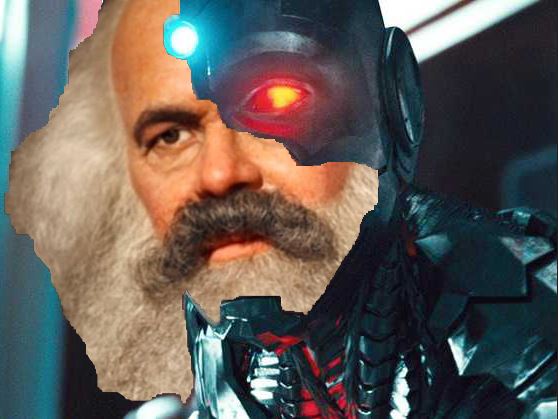
else is missing. Bastani’s steampunk portraiture—Marx’s telescopic eye
short-circuiting his own beard afire—sidelines the ways capitalist tech, and
the limited problems its owners choose
to solve, penetrate our social relations at their foundations. The modes of production Bastani celebrates
in capitalism co-produce the relations
of production—capital dominating the proletariat—to which he says he objects.
In agriculture, for instance, the gene editing Bastani champions isn’t really about solving problems presented in an albeit historicized natural economy still dependent on the sun, seasons, and organisms’ life cycles. These problems are dealt with in direct terms today by those agroecologies worldwide that haven’t been smashed by capitalist land grabs. The latest and greatest in genetic engineering aren’t needed where traditional breeding programs are perfectly capable even under rapid climate change. Proprietary GMOs are more about looping farmers into a ratchet of production that both subjects them to labour discipline and helps garnish the near-entirety of farm revenue.
Indeed—funny enough given Bastani’s tech fetish—capital is perfectly happy trashing research and development if its monopolies in economy and State power succeed in depressing competition and externalizing such costs of production to labour, consumer, government, and nature. In other words, the efficiencies for which capital incessantly searches, squeezing out every iota of surplus value, often have little to do with commodity production directly.
New tech can even get in the way of profit. Solar energy is only the most obvious example. But the drag is everywhere. Alongside reducing the number of breeding lines across plant and animal species, agribusiness consolidation reduces the numbers of geneticists working in the sector. Homogenization divorced from the biologies and behaviors of livestock extends to the science pursued.
Tech’s environmental hoaxes
By
these trajectories, Big Ag, emblematic of other industries, corners itself into
some darkly hilarious traps of its own making.
In the face of African swine fever, presently the world’s largest-ever livestock disease outbreak, the hog sector is pursuing suddenly fashionable facial recognition software to keep track of sick pigs (without changing the husbandry that sickens them). Despite efforts on the part of the sector to blame backyard producers, the outbreak is progressing hand-in-hoof with sharp increases in the numbers of total and per-farm head, declines in hog diversity, explosive growth in international exports shipping millions of head country-to-country, and a system design disallowing hybrid hogs who survive from breeding on-site and passing on their immunity. The incapacity to respond to African swine fever and other deadly diseases is built into the economic model before a single hog gets sick.
In other words, the sources of liberation technology Bastani upholds in actuality embody the very alienation to which Marx objected, divorcing both nature and humanity from possible solutions as problems arise. I’m not the first to point this out. Rut Elliot Blomqvist directly addressed this gap in Bastani’s argument last year. But power, as apparently playacted by the ecomodernist Left, is found in refusing to respond to such counternarratives with anything other than tweeted insult.
There are other interactions between our two sources of wealth—labour and the environment—that belie tech’s easy payoff. The environment can destroy labour and machines; earthquakes, for instance, to choose what was up until fracking the least socialized “natural” disaster outside a meteor strike. Of course, choosing to build a nuclear facility on a major fault is entirely money over matter run amok.
By the second contradiction of capitalism, labour and tech, in the other direction, can destroy the environments upon which they depend. Much of colonialism involves spatial fixes by which this damage is externalized onto the Indigenous, up until imperial might or the resources themselves or both run out. The cycle of accumulation then retracts into internal colonization as capital cashes out, as in the case of fracking in the U.S. Unless the resulting damage just offers the next window of investment, as, for instance, with oil and sand opening up in a melting Arctic.
Should
the chain of relative opportunities conclude in abandoning the planet, dead
Mars, as even well-intended techno-optimism has cheered, somehow
represents a happy ending and not a recursion spun off into space. A Hard Timesheadline summarized an
analogous trap in all its dialectical tragicomedy: “Desperate Attempt to Escape
Mosh Pit Looks Exactly Like Moshing.”
As
Marxism has long observed, even under the neoclassical model, tech repeatedly
drives itself into a ditch. Innovations score quick profits until the new fixed
capital spreads, competition intensifies, and economic crises precipitate, to
be alleviated, or, better put, reconstituted by exports, monopoly, and war.
And by out-and-out murderous fraud. As we learned earlier this year, why deliver a fully functioning plane when you can upsell basic safety features? With Big Pharma in a productivity crisis, and the number of new drug classes in secular collapse, Sackler-owned Purdue Pharma pursued a “Project Tango” by which it sold cures to the opioid addictions that company reps, “turbocharging sales,” pushed doctors to prescribe in the first place. The company, turning rent-seeking from land to body, aimed to make itself an “end-to-end pain provider.”
In promising fully automated communism, left technologism quietly factors out our present pace in tech evolution from the market cycles underlying it.
Another round of innovation isn’t necessarily about use value, as tech-optimists focus on, but on resetting such market grifts. As the payoff is the endpoint that matters, many an innovation is only tangentially related to what the commodity is used for by the consumer. In promising fully automated communism, left technologism quietly factors out our present pace in tech evolution from the market cycles underlying it. But planned obsolesce and other such sleights-of-hand shouldn’t be folded in as virtues in any vision of modern communism.
It isn’t just the resulting despoliation of land and sea that shows environmental conservation is antithetical to the rules of this game. Against the hype of green capitalism, more efficient production, say, growing more food per hectare, doesn’t save the environment. By the Jevons paradox, such successes only spread out, taking the lead eating through the “saved” resource. Along the way, as more of the resource is destroyed, what’s left of what once was part of our shared commons suddenly accrues value it never had. Under Lauderdale’s paradox, a decaying resource base isn’t grounds for good corporate governance but serves as the basis for a fight for the leftovers, as in the case of the multinational rush for the last of the world’s “virgin” farmland in Africa.
As if right off the pages of the National Review, left accelerationists square this circle by dismissing environmentalism as neo-Malthusian catastrophism. There are no ecological precipices, they claim. A boundless nature automatically cleans up after humanity’s expropriation. Water, for one, doesn’t disappear, Jacobin accelerationist and Verso author Leigh Phillips posted on a recent Facebook thread, it just transforms into another form something else in the food chain can use. It’s a Žižekian gambit, the philosopher’s lateral lisp ablazing: DEY VILL BE MORE ECOSOCIALISH DAN DA ECOSOCIALISH DEMSHELVE. With a neoclassical faith in Earth’s regenerative powers that outstrips the biosphere itself.
Back on this planet, on the other hand, with an uneven relational geography of per capita freshwater use largely driven by global North agriculture and industrial production alienated from the very ecological processes appealed to here, many a region’s quantifiable, and, yes, limited supply of potable water is crashing out.
History isn’t deterministic
The
ecomodernist missteps track back to inception.
Marx
hypothesized capital originated in a similar if era-specific game of socioenvironmental
whack-a-mole. To return to the very Grundrisse
to which accelerationists appeal and, as excerpted here, in the earlier German Ideology he wrote with Engels, Marx
traced capitalism’s genesis as a spiraling dialectic of population, machine, expropriation,
and geography:
“The labour which from the first presupposed a machine, even of the crudest sort, soon showed itself the most capable of development. Weaving, earlier carried on in the country by the peasants as a secondary occupation to procure their clothing, was the first labour to receive an impetus and a further development through the extension of commerce. Weaving was the first and remained the principal manufacture. The rising demand for clothing materials, consequent on the growth of population, the growing accumulation and mobilisation of natural capital through accelerated circulation, the demand for luxuries called forth by the latter and favoured generally by the gradual extension of commerce, gave weaving a quantitative and qualitative stimulus, which wrenched it out of the form of production hitherto existing.
Alongside the peasants weaving for their own use, who continued with this sort of work, there emerged a new class of weavers in the towns, whose fabrics were destined for the whole home market and usually for foreign markets too. Weaving, an occupation demanding in most cases little skill and soon splitting up into countless branches, by its whole nature resisted the trammels of the gild. Weaving was therefore carried on mostly in villages and market-centres without gild organisation, which gradually became towns, indeed the most flourishing towns.“
That
is, by its very own combos of due cause and historical
chance, feudalism arrived upon the circumstances that prefigured
capital. In a dizzying dance, the effects of one feudal process turned into the
causes of another, to and fro.
So
contrary to tales left and right of capitalism’s genesis, capital never sprang
from Adam Smith’s or Milton Friedman’s (or Dr. Dre’s) head fully formed. The
transition in the prevalent mode of production, as Marx and Engels tie it off
here, emerged woven out of conditionally translated factors:
“With gild-free manufacture, property relations also quickly changed. The first advance beyond natural, estate-capital was provided by the rise of merchants whose capital was from the beginning moveable, capital in the modern sense as far as one can speak of it, given the circumstances of those times. The second advance came with manufacture, which again made mobile a mass of natural capital, and altogether increased the mass of movable capital as against that of natural capital. At the same time, manufacture became a refuge of [free labour] peasants from the gilds which excluded them or paid them badly, just as earlier the gild-towns had served as a refuge for the peasants from the oppressive landed nobility.”
Feudalism could very well have ended a different way. If we leap-frog forward into what we presume will be the far side of the age of capitalism, we should expect a similar storyboard, with cause and effect and happenstance pinballing back and forth. Facile determinism was, and will never be, the order of the day. Stochastic outcomes burble out from between social systems’ historical constraints.
Liberation,
then, isn’t just a matter of seizing physical factories, as if the objects they
produce, the ring of all rings, my precious, are revolution in a package. It’s fascinating
the extent to which some liberals grasp this point better than our leftish
techno-determinists. In encapsulating the grim scientific projections for
climate change in his recent book, a David
Wallace-Wells still bewitched with “our” present lifestyle hedged that
“these twelve threats described in these twelve chapters yield a portrait of the future only as best as it can be painted in the present. What actually lies ahead may prove even grimmer, though the reverse, of course, is also possible. The map of our new world will be drawn in part by natural processes that remain mysterious, but more definitively by human hands. At what point will the climate change grow undeniable, un-compartmentalizable? How much damage will have already been selfishly done? How quickly will we act to save ourselves and preserve as much of the way of life we know today as possible?
For the sake of clarity, I’ve treated each of the threats from climate change—sea-level rise, food scarcity, economic stagnation—as discrete threats, which they are not. Some may prove offsetting, some mutually reinforcing, and others merely adjacent. But together they form a latticework of climate crisis, beneath which at least some humans, and probably many billions, will live.“
The urban legend that Marx saw the most industrially advanced countries as necessarily the communist vanguard was dead wrong.
One can see why historian Eric Hobsbawm, bashing the arguments of Jacobin publisher Bhaskar Sunkara’s socialist manifesto before it was fashionable, insisted, as much as a matter of method as fact, that the urban legend that Marx saw the most industrially advanced countries as necessarily the communist vanguard was dead wrong. In fact, Hobsbawm continued, for better or worse, Marx and Engels placed early bets on a revolutionary (and decidedly agrarian) Russia:
“No misinterpretation of Marx is more grotesque than the one that suggests that he expected a revolution exclusively from the advanced industrial countries of the West…
Engels records their hopes of a Russian revolution in the late 1870s and in 1894 specifically looks forward to the possibility of ‘the Russian revolution giving the signal for the workers’ revolution in the West, so that both supplement each other.'”
Such a series of retroactive reversals—an ecological Marx, the gap between tech and problem-solving, and the possibility that communisms can emerge on the periphery out of a different combinatorial of production—is hard to assimilate if you’ve founded your political program upon radicalizing commodity fetishism at capital’s centre.
Turning outer space into Flint
The
particulars are as goofy as they are galling.
If,
as it appears in his Times piece,
Bastani thinks food is only about basic nutrition or good taste (however
important these both are), then he has bought exactly into an agribusiness
productivism that making lots of (marketable) food is the task at hand.
No
wonder lab meat and other examples of cellular agriculture ring his bell. Never
mind food fully engulfed by industrial processing represents the next
generation in expropriation. No peasant
in the Amazon helping cultivate regenerative agroecologies need apply under Amazon’s (or Uber’s) business
plan for drone-striking edible petri dishes to your shipping container’s door.
Never mind such pellets are being produced by the very venture capital that helped
bring about the environmental crises in the first place. It’s as if tech frisson
alone is enough of a rationale to keep capital in power and objections to cease
fire.
Food sovereignty, in contrast, extends beyond such vulgar food security to a people’s right to control their land and labour in the course of producing culturally appropriate food they—they!—wish to grow and eat, if under the constraints of regional planning and wider gyres of global circulation.
Bastani’s wanton oversimplifications extend to health and energy. In an age of poisoned water in Flint, Michigan and the opioid epidemics spreading across farming communities around the world, he calls for tech-led interventions into health that are grounded in commoditization-friendly preformationisms about human biology. Health and disease are inside you from the start. One just needs a pill or genetic intervention to cure you. But in reality, such reductionist medicine works for only some diseases and is conspicuous in its dearth of notions of shared public health outside pharmaceutical market shares.
Backing an anti-Marxist ecology, Bastani pegs our energy demands to mining asteroids. Marx’s “Theft of Wood” in outer space. At what cost to Earth will it take to get us up there? Who will control the mines across The Expanse? Does this political economist’s effort to think through the likely political economy to emerge out of such a program extend beyond the cheery engineering porn many such Left proponents can’t seem to understand as it is?
Philosopher
Alain Badiou is scathing of such a
cheap politics, in this case so literal in its actualization:
“Blind worship of ‘novelty’ and contempt for established truths. This comes straight out of the commercial cult of the ‘novelty’ of products and out of a persistent belief that something is being ‘started’ that has already happened many times before. It simultaneously prevents people from learning from the past, from understanding how structural repetitions work, and from not falling for fake ‘modernities.'”
A Left actually working in the natural sciences is arriving at different conclusions, sketching out the horrific details of emerging capital-led tech.
Over
a series of technical monographs (here,here, and here),
mathematical epidemiologist Rodrick Wallace uses information theory and control theory to show
efforts at developing artificial intelligence for driverless
cars or electric grids are grounded upon badly supported models of human
consciousness. The resulting fast-tracked experiments in silicon cognition,
conducted on public roads with little regulatory supervision, are lining up as
high-stakes demonstrations of what Wallace has described as machine psychopathology:
“The asymptotic limit theorems of control and information theories make it possible to explore the dynamics of collapse likely to afflict large-scale systems of autonomous ground vehicles that communicate with each other and with an embedding intelligent roadway. Any vehicle/road system is inherently unstable in the control theory sense as a consequence of the basic irregularities of the traffic stream, the road network, and their interactions, placing it in the realm of the Data Rate Theorem that mandates a minimum necessary rate of control information for stability. It appears that large-scale [vehicle-to-vehicle and vehicle-to-infrastructure] systems will experience correspondingly large-scale failures analogous to the vast, propagating fronts of power network blackouts, and possibly less benign but more subtle patterns of individual vehicle, platoon, and mesoscale dysfunction.”
The moral calculus of the resulting accidents—who will driverless cars choose to kill—is giving even sociopaths such as Henry Kissinger the kind of pause that escapes our future-so-bright Left.
The information and tech revolutions Bastani presents as a cheap exit out of our present mess are proving costly even on days in which operations work perfectly.
The
information and tech revolutions Bastani presents as a cheap exit out of our
present mess are proving costly beyond such failures, even, much like infamous Bitcoin, on days in
which operations work perfectly. Technology
Reviewreports:
“In a new paper, researchers at the University of Massachusetts, Amherst, performed a life cycle assessment for training several common large AI models. They found that the process can emit more than 626,000 pounds of carbon dioxide equivalent—nearly five times the lifetime emissions of the average American car (and that includes manufacture of the car itself).”
The
fully automated communist equivalent, sharing similar presumptions, much as Stalin and Cargill on industrialized
agriculture or the convergent political ergonomics behind Chernobyl and Three Mile
Island, would likely differ little in its catastrophic outcomes
save perhaps who exactly picks up the tab.
In
parallel to the misplaced magical thinking that disappears such inconveniences,
the ecomodernist program is fitted with a political tin ear as if a single EarPod
(the other lost at a boozy IPO launch). “Let’s leave Earth!” enthuses one of
its planks.
Now there’s a rallying cry for the proletariat who are to be left behind. Space exploration extending beyond telescopy and into colonization represents the kind of innovation in accumulation that until now has given only more power to the Jeff Bezoses of the world. Or the Adam Dunkels, in the social democratic version. Through the guarded gate of a gravity well and with every canister of food, water, and air necessarily manufactured—and, as in Flint’s water, turned into a fictitious commodity—the powerful, already remote-programming on-the-spot firings, would be better able to control the people Bastani claims he aims to liberate.
Socializing sciences for the people
Even
on their own terms, these phantasmagorias suck. Are other futures possible?
Ecosocialism and ecocommunism aim to transform society “away from socially and ecologically destructive systems.” Our capacity to socially reproduce ourselves as a species requires we integrate production, conservation, and human liberation—across labour, race, indigeneity, and gender, among other axes.
Against
ecomodernist smears, alternatives in ecosocialism (here,here, and here, for a starter kit) aren’t organized
around prelapsarian fantasies of returning to a mode of production that existed
nowhere save in the minds of its critics. They are not, as left business
observer Doug Henwood and other accelerationists repeatedly
troll, neo-primitivisms championing eating twigs, living in huts, and reducing
the human population by 90%.
“[Accelerationism’s]
main shortcoming,” anarchist social theorist Kevin Carson rolls his eyes,
“is a failure to understand the significance of the technologies it sees as the basis for the post-capitalist system. Although Accelerationism celebrates advances in cybernetic technology and network communications as the building blocks of post-scarcity communism, it is tone deaf when it comes to the specific nature of the promise offered by these technologies, and actually runs directly counter to them. This failure includes a lazy conflation of localism and horizontalism with primitivism and backwardness (to the point of treating ‘neo-primitivist localism’ as a single phrase), and a lionization of verticality, centralism and planning.”
“[The] Severing [between the reality of a human-centric world and the real of ecological symbiosis across species] has produced physical as well as psychic effects, scars of the rip between reality and the real. One thinks of the Platonic dichotomy of body and soul: the chariot and the charioteer, the chariot whose horses are always trying to pull away in another direction. The phenomenology of First Peoples points in this direction, but left thought hasn’t been looking that way, fearful of primitivism, a concept that inhibits thinking outside agrilogistic parameters [of an industrial ecology without nature].”
Agroecologies and other community-led models mind this gap, organizing their ethoses around nature’s intrinsic fecundity while regularly adapting to the latest that soil and other regenerative sciences have to offer when made available. Along the way, these ‘back road’ methods refuse to divorce modes and relations of production as a matter of first principle. Nor do they just hand over their land and labour to assuage the brand loyalties upon which the Henwoods of the world glom as if in existential terror.
In something of an afterthought in the best annihilation of the ecomodernist program I’ve read this year, development sociologist Max Ajlexplains how new tech can indeed be used, but from the start must be folded into a recursively negotiated model of how we are to socially reproduce ourselves as a society:
“A second potential course of action is devoting as much research as possible into lessening the difficulty of the [agriculture] labour involved, through—of course!—technology. In both [what is now capital’s] core and periphery, how much farming will be mechanized and, more importantly, which tasks should not be mechanized remain open questions. So, too, is the meaning of mechanization, and what kinds of tools can spare labour without excess energy-intensive extraction. How much we can replace hard labour with constant attention through human presence and careful intervention in natural cycles is another open question.”
In
describing a novel municipal food program in Brazil that central planning, without
a single robot deployed, scaled
up to feeding hundreds of thousands from forest-adjacent farm to city table,
political agroecologist Jahi Chappell suggested our social
institutions can be as unworldly an advance as any handheld gadget:
“The truth is that the future will be based not on the promises of whiz-bang technology, but on the more mundane features of the decisions our societies make about what we will do, how we will do it, and who will get to decide. That is, our future fates are based on our institutions. ‘Institutions,’ as a technical term, refers to the rules prevalent in a society. They are essentially about how we run our lives individually and collectively, and the many conscious, and unconscious, mechanics underneath the surface. Our ancestors would likely be just as shocked at these institutional foundations of our current societies as they would be at the tools and technology that support them. Institutions, in this way, are as much the stuff of sci-fi fantasy as bleeding-edge plant breeding techniques and the Dick Tracy wrist-radio/watches some of us now wear on our wrists.”
It’s as if, as environmental humanities scholar Anthony Galluzzo posted recently, humanity, not tech is—ha—the engine of history. Again, it’ll be people, not science alone, environmental scientist Erle Ellis wrote in another Times op-ed, who’ll save us from ecological collapse.
Tech bros win-winning the world away
So what to make of this fringe of Marxian tech bros with outsized access Chappell and Galluzzo dubbed the Jetsonian Left, beyond its recapitulating industry’s penchant for finding due cause in objects, rather than in an ecosocial scope capital can’t easily flip into commodities?
Given the generic corporate marketing in what presents itself as anti-capitalist doctrine, one of the few explanations that lines up the albeit scattered dots is that Bastani and his fellow Prometheans see something they like of themselves in their bourgeois enemies. It may explain in part why Bastani, hog-tying himself this way, got his ass whipped on TV by a doddering foursome of system apologists.
And capital, so skilled at such flattery, is happy to oblige. By historian Joseph Fracchia’s account, Marx saw materialism outside merely the “stuff” of the world. Capital also deploys innovations in the social and the semiotic—through many of Chappell’s institutions it’s captured—to help organize production and the greater cultural environment in its favor.
The resulting dynamics now playing out are textbook. Reformists, observed historian Doug Greene on Facebook, are demanding revolutionaries skip what was the centennial of an outdated communist revolution. Also, they continue, “‘We should adapt the exciting ideas of [long-dead social democrat] Karl Kautsky!‘”
When the spectre of revolution re-emerges—percolating today from the Yellow Vests to Sudan and it seems increasingly underneath elsewhere—there’s always room for Leftists who propose more of the establishment as the radical path forward. It’s a road their capitalist allies and even out-and-out employers—Galluzzo points out Jacobin author Leigh Phillips works for the nuclear industry—would never let them anywhere near commandeering.
With capitalists scared sleepless by revolution, redwashing has re-emerged.
In
other words, there’s always a future, even a communist futurism, for useful
idiots too smart to fail. With capitalists scared sleepless by revolution,
redwashing has re-emerged. While the
term has been used to denote corporate donations to Indigenous causes or redbaiting progressives, in the face
of growing public abjection, the
capitalist class now appears searching for the shelter of left paraphernalia
beyond selling back revolt.
And
the customer-centric talent that capital seeks, showing up as if incarnating an epochal
process, is now offering to scale up these win-win deliverables. Just six
months ago, his Fully Automated
manuscript already in press at Verso, Bastani tweeted:
“I’m a big fan of capitalism from 1800-1980. It’s just now that record is facing serious, sustained, and arguably secular challenges.“
Just now, mind you. After Native American genocide, Black slavery, Victorian holocausts, child labour, the Great Depression and Nazi Germany, Vietnam and fifty years of other proxy wars, and environmental ruination across the global South. “Challenges,” he calls them, as if on spec, pitching some Silicon Valley moneybags. Because, yeah, those guys, biohacking their computer selves to liver failure or dying in line at the Mount Everest gift shop, should arbitrate the world’s next steps.
The automation pursued out of such base appeals may be increasing in extent and luxury, but there’s little communist about it. People and the planet deserve far better.
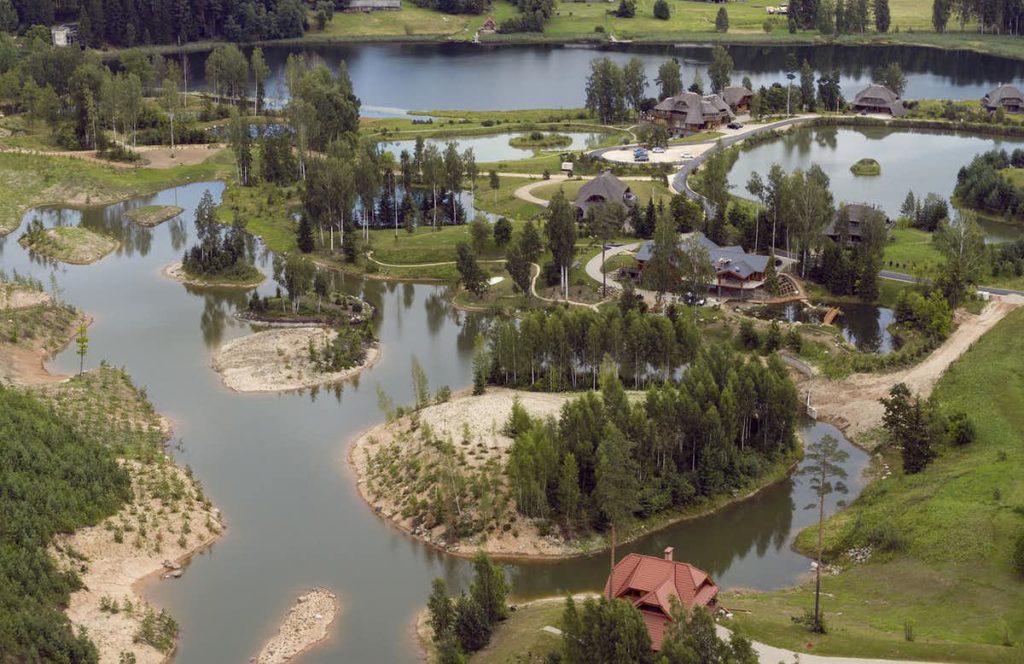
A Latvian ecovillage based on The Ringing Cedars of Russia. (Santa Zembaha/Wikimedia Commons, CC BY-SA)
Once a month, we put together a list of stories we’ve been reading: things you might’ve missed or crucial conversations going on around the web. We focus on environmental and social justice, cities, science fiction, current events, and political theory.
We try to include articles that have been published recently but will last, that are relatively light and inspiring, and are from corners of the web that don’t always get the light of day. This will also be a space to keep you up to date with news about what’s happening at Uneven Earth.
Not Afraid of the Ruins is back! In June, we launched the second season of our series of science fiction with an environmental justice twist. And we have two excellent new articles for you, one on women’s organizing against extractivism in southern Africa, another continuing the debate on utopia and science, by Max Ajl. We also highlight more articles criticizing Fully Automated Luxury Communism, and feature a discussion on the merits of and problems with utopian thinking. Finally, we are featuring an older article by Peter Staudenmaier on fascist environmentalism—something every ecologist should be aware of.
Uneven Earth updates
The right to say no | Link | Women organizing against extractivism in southern Africa
All the water | Link | “Everything was on autopilot; the only thing the operator had to do was push a virtual button to engage the missiles.”
Dispatch from the Isthmus of Tehuantepec | Link | What it will take to build alliances with our neighbors to the South
To stop destruction of Liberia’s rainforest, he put his life on the line. Alfred Brownell had to flee Liberia after challenging the powerful palm oil and other extractive industries that were clearing its forests. But he remains committed to seeing that the West African nation’s biodiverse lands be developed sustainably and the rights of its indigenous peoples respected.
The mindfulness conspiracy. It is sold as a force that can help us cope with the ravages of capitalism, but with its inward focus, mindful meditation may be the enemy of activism.
How ‘maintainers’, not ‘innovators’, make the world turn. “The vast majority of technologies that surround us and underpin our lives are not innovations, and the vast majority of labor in our culture is not focused on introducing or adopting new things, but on keeping things going.”
Por
tercera vez durante cuarenta minutos, Olga daba vueltas entre la sala y la
cocina buscando los anteojos. Era extraña su manera de buscar las cosas, pues
aunque ya hubiera revisado dos o tres veces en el mismo lugar, lo volvía a
hacer sabiendo que no encontraría nada. Para concentrarse mejor, subía el
volumen de la música que estaba escuchando [estridente ya de por sí]. Pero
nada. Los anteojos esta vez parecían haber desaparecido. Angustiada porque sin
ellos no podría hacer la mayor parte de las actividades planificadas para ese
día, se recostó un momento a lado de la puerta de entrada, donde sentía que el
aire rozaba directamente su cuerpo [al menos más que por
la ventana, donde las oleadas eran siempre breves y tibias]. Entonces escuchó
los golpes.
Se
sobresaltó un poco, porque siempre que se visita a alguien, se toca el timbre y
no la puerta –a golpes– de la casa en cuestión. La extrañeza que sentía al
saber que había alguien allá afuera era doble porque casi nadie llegaba hasta
ese extremo del pueblo para ir a buscarla. Pensó que si no se movía,
quienquiera que estuviera del otro lado de la puerta se iría pronto. Pero
después de cinco minutos, algo dentro de su pecho empezó a tensarse, como si
supiera que la inmovilidad era algo poco natural en esa posición. Los golpes
seguían, cada vez más desesperados, y esa insistencia le produjo un choque
eléctrico que le recorrió las vértebras, obligándola a levantarse y abrir, con
violencia, la puerta.
– ¿Qué
te pasa? ¿Por qué pegas así? ¿Qué no ves el timbre?
– ¡Lo
he tocado ya muchas veces, pero quizá usted no lo ha escuchado! ¡Yo oigo
perfectamente lo que suena ahí dentro! –dijo El Visitante, casi a gritos.
Olga se
le quedó viendo, callada, atendiendo al sonido más que a él. Veinte segundos
bastaron para darse cuenta de que los ruidos provenientes del estéreo envolvían
no sólo todo el espacio tras su espalda, sino el jardín entero y la enramada
que llevaba al pueblo.
–
¡Aaaaah…! A ver, espera, voy a bajar el volumen.
Pero él
la tomó del brazo y le dijo que lo escuchara primero, antes de volver a entrar.
– Usted
no me conoce, pero creo que debería asomarse a la habitación del primer piso de
su casa y sacar de ahí al bisonte que acaba de entrar por la ventana.
– ¿Un
bisonte?
– Es un
bebé bisonte, no se asuste.
– ¿Pero
qué tiene que hacer un bisonte –grande o chico– aquí, a la orilla de un
acantilado patagónico, donde pega el aire térmico más denso del Sur del mundo?
– ¡Ah!
Eso quisiera yo explicarle. Mire, esa especie de bisonte no es muy popular; de
hecho sólo existen tres en el Cuadrante Cósmico Oriente, y usted tuvo la mala
fortuna de encontrarse en las coordenadas donde ubicaron a Luly… así se llama…
Olga lo
interrumpió con una mirada brusca, inquisitiva.
– No, a
ver, espera. Más raro que rondar una zona por donde sólo se puede pasear de
noche, lo que yo me pregunto es cómo hizo un bebé bisonte para subir al primer
piso de mi casa y entrar por la ventana.
– Justo eso es lo que estaba…
– ¡No!
¡Espera! En realidad, lo que no entiendo es para qué carajos va a querer entrar
un bebé bisonte a mi cuarto, y cómo sabes que es un bebé y que trepó hasta ahí.
Digamos… Si lo estás viendo trepar, ¿por qué no lo detienes, aventándole una
piedra, o asustándolo a gritos, o algo? Y en vez de eso esperas hasta que esté
dentro y entonces sí tocas la puerta, como desquiciado, sin pensar…
– Ahora
espéreme usted a mí. No hay necesidad de exaltarse tanto. Bueno, es natural
dada la situación; pero me parece que si escuchara lo que intento explicarle
acerca de ese bebé bisonte, comprendería mejor por qué sólo debe subir y
animarlo a salir de ahí, ofreciéndole un pedazo de carne roja cruda marinada en
miel. Yo le ayudo a prepararla si quiere, señorita… ¿Cómo se llama?
El
Visitante se animó a dar un paso, con la intención de cruzar el umbral de la
puerta, pero Olga se le adelantó, saliendo al jardín y haciéndole un gesto con
la cabeza, para que volteara hacia arriba:
– Soy Olga…
Me hablas como si te diera lo mismo que ahora yo te dijera “¡Mira, un tiburón
atraviesa el cielo tragándose todas las nubes!”.
El
Visitante se quedó callado, pensativo. El fondo del cielo se abrió de pronto ante
sus ojos y, sin poder evitarlo,
sostuvo la mirada allá arriba, el tiempo suficiente para visualizar cualquier
atrocidad entre las nubes.
–
Satisfacer el hambre de un tiburón debe ser mucho más terrible que lo que hay
que hacer con el bebé bisonte. Y en realidad no es tan complicado –dijo El
Visitante, mientras se asomaba al interior de la casa, decidido a entrar–, a
menos que usted esté embarazada.
–
¿Embarazada?
– Sí.
Si usted está embarazada, el bebé bisonte no se irá hasta que el feto muera y
pueda sorberlo a través de su ombligo.
II
Entraron
directo a la cocina. La música había terminado hacía rato, y era más fácil
distinguir los ruidos dentro y fuera de la casa. En particular, estaban atentos
a los movimientos que se adivinaban en el piso de arriba: el bebé bisonte
parecía estar dando vueltas alrededor de la cama, pero los intervalos de sus
pasos denotaban una pausa muy larga justo cuando llegaba a la cabecera… Es como si se detuviera a inspeccionar la
almohada y luego siguiera adelante, pensaba Olga, sin apartar la mirada del
techo, justo hacia el punto donde se encontraba su habitación, allá arriba.
– ¿Qué
estará buscando el bicho ése en mi cuarto?
– Usted
no sabe la cantidad de información que se desprende de su cuerpo mientras
duerme, señorita Olga… Un bebé bisonte de la especie Metamphynus baalis es capaz de distinguir los humores fertilizados
de las mujeres en los restos del sueño, y no me refiero tan sólo a la saliva,
el sudor o los cabellos que se desprenden durante esos lapsos de inconsciencia,
sino a lo que su cuerpo onírico exuda: muchas veces, la vida que transcurre en
duermevela no llega a manifestarse en la vigilia, a la luz del día, pero
algunos de sus pasajes suelen detonar sucesos que ocurren cuando usted
despierta. O viceversa. En este caso, si usted está embarazada y aún no es
consciente de ello, el bebé bisonte lo descubrirá después de olfatear o lamer
tales exudaciones expuestas, evidentemente, en las sábanas y la almohada de su
cama.
– Y si
lo estoy, querrá pegárseme al ombligo y tragarse por ahí al óvulo fecundado… Es
como si él supiera…
–
Exacto: que usted no desea un hijo.
– Pero
no me he realizado ninguna prueba… ¿Qué tal que no estoy embarazada y el bebé
bisonte termina por sorberme el estómago y las vísceras; o le hacen daño mis
jugos gástricos?
– Sólo
hay una forma de averiguarlo. A ver, dígame una cosa: ¿usted ha expuesto su
organismo al riesgo de ser incubado?
Ambos
se quedaron en silencio, mirándose.
– Sí.
Pero se suponía que el Exoesqueleto no quería eso. Ni yo. Ya sabes que sólo
cuando ambos organismos comparten la visión reproductiva al momento del acto
sexual, se puede dar una fertilización híbrida. De otra forma, no es posible
que la información genética de ambas especies se configure en una sola… ¿Y
entonces?
– Pues en
este caso, el inconsciente de alguno de ustedes –o de ambos– transgredió los
límites entre las leyes racionales de este mundo y las leyes naturales de
alguno –o varios– mundos espejo.
– Pero
yo no quiero un hijo. Nunca lo he querido; ni en esta vida ni en ninguna otra… No
tiene sentido.
– Sí y
no, señorita Olga: por eso el bebé bisonte está aquí.
III
El
silencio les hizo interrumpir la conversación. Al parecer, todo había vuelto a
la calma allá arriba. Se miraron un momento y El Visitante hizo un gesto con la
cabeza, indicándole que fueran a ver. Sin embargo, justo cuando iban a abrir la
puerta de la cocina, él la tomó del brazo, deteniéndola otra vez, pero ahora
con más fuerza. Un bramido como de agua borboteando era todo lo que se
escuchaba, y ese todo, indicaba sólo
una cosa: el bebé bisonte preparaba el camino entre sus fauces, su tráquea y su
flora intestinal, asegurándose de salivar y humedecer bien la lengua y los
labios de su inmenso hocico.
– Es
importante que usted no tenga miedo. El bisonte, de cerca, le parecerá más
grande de lo que es, y el proceso será incómodo, pero no dolerá. Si le teme, el
bebé bisonte recibirá una señal confusa entre lo que debe y no debe hacer, y…
– ¿Y?
¿Has estado presente otras veces, mientras esto sucede, como ahora? No me has
dicho qué pasará con mi organismo después de esto. ¡¿Cómo me pides que no tenga
miedo ante un bisonte succionador?!
– Es la
primera vez que una Incubada me abre la puerta y me escucha. Yo sólo he leído
sobre estas cosas, y deseo atestiguarlo desde hace años. Pero no… nunca…
– ¿Y
los textos? ¡¿Qué dicen los textos; cuáles son los resultados?!
– ¡No
lo sé…! Siempre se habla de la culminación exitosa de este proceso; de lo bien
que funciona el instinto del bebé bisonte; de lo importante que es no
interponerse en su labor; de la necesidad de evitar el término de cualquier
fertilización no deseada; de…
El
Visitante no pudo decir más al ver la enorme cabeza del bebé bisonte que
asomaba ya por la puerta de la cocina. Olga comprendió que aquello de bebé, como siempre, obedecía a una
noción distinta dependiendo de la especie y del mundo espejo del que provenía.
Intentó controlar la impresión de que el inmenso animal la tragaría entera,
pero su reacción al miedo fue curiosa: empezó a escupir todos los dientes
delanteros en la palma de su mano y se los entregó a El Visitante, para que
tuviera constancia de lo que estaba a punto de atestiguar por primera, y quizá,
única vez.
Iliana Vargas (Ciudad de México, 1978). Estudió Letras Hispánicas en la Facultad de Filosofía y Letras de la UNAM. Narradora de ficción especulativa, es autora de Joni Munn y otras alteraciones del psicosoma (2012); Magnetofónica (2015) y Habitantes del aire caníbal (2017). Formó parte de The Mexicanx Initiative, para participar en la WorldCon76, en San José California.
Este cuento fue editado por Diana Vela Almeida.
Este cuento es parte de Not afraid of the ruins, nuestra serie de ciencia ficción e imaginaciones utópicas.