GDP

by Doug Banks

What is GDP?

Gross Domestic Product, or GDP, measures economic activity. Technically speaking, it equals the sum of all goods and services produced within an economy over a certain period. To oversimplify it, we could think of GDP as the sum total of all the price tags within a country’s borders. Metaphorically speaking, GDP is the only universally-recognised heart-rate monitor for determining the health of capitalist economies. Capitalism operates on economic growth, and GDP measures growth. 

Because of this, GDP has become the most influential political and economic metric in the modern world. Governments, corporations and institutions use it to direct resources, frame discussions, and inform crucial decision-making. 

And ever since GDP became our universal stand-in for social progress, it has had the effect of reshaping entire societies in its own image—which is problematic, as GDP is a very sexist, western-centric, careless, ecologically-destructive, and altogether bad image.

Where did GDP come from?

Before the 1930s, to paraphrase the sociologist Daniel Hirschman, the economy as we currently know it ‘did not exist.’ But that’s not to say that our ancestors didn’t act economically. People have been making, buying, and trading things basically forever. But it was only in the decade before World War II that our current understanding of the economy—as something that can be examined, diagnosed, prescribed and intervened upon—was conceived.

It was only in the decade before World War II that our current understanding of the economy—as something that can be examined, diagnosed, prescribed and intervened upon—was conceived

Gross National Product, the precursor to GDP, was invented by the economist Simon Kuznets to help the U.S. recover from The Great Depression. His logic was simple: their economy was obviously broken, but before they could fix it they needed to figure out how to measure it. GNP became the first widely-adopted method of measuring an economy, until the U.S. replaced it with GDP in 1988. (GNP measured all economic activity by a country’s citizens, regardless of where they were in the world. GDP measures all economic activity within a country’s borders, regardless of the nationalities of the people involved.)

How did GDP become important?

In 1944, as World War II was winding down, the leaders of the Allied Nations met in Bretton Woods, New Hampshire, to decide how the world would be rebuilt. They set in motion a few things that would change the course of history forever. First, they cemented GNP (and then GDP) growth as their standard tool for measuring economic progress and development. 

Then, to help reinforce this emerging world order, they established intergovernmental institutions such as the International Monetary Fund (IMF) and the World Bank, and later the Organization for Economic Co-operation and Development (OECD) and the World Trade Organization (WTO). Promoted as the flag-bearers of international development, many of the programmes these institutions have overseen dismantled national sovereignty in the Global South to install Western-friendly and GDP-centric policies. 

Capitalism, by definition, must expand. For half a millennium private firms and individuals have been finding new ways to grow their wealth. But it’s only since the Bretton Woods Conference that pursuing a single, standardised metric of economic growth has become the primary public objective of almost all of the world’s most influential governments and institutions. From that moment onward, we have lived in a world religiously devoted to the pursuit of GDP growth—often at the expense of everything else.

Why is GDP a problem?

GDP was designed to measure an economy getting ready for war, but now it’s used to measure social progress in general. This mutation was already obvious during the Cold War, when GDP became the ideological benchmark for comparing the relative success of capitalism and state socialism. 

Today it’s no different. If a country grows its GDP faster than others, they can claim they’re ‘winning’ at the game of international development, and it’s implied that this will automatically improve the quality of life of its citizens. 

GDP serves as a ‘scorecard’ for political success, which means policymakers will generally favour and implement the policies that will increase it

GDP serves as a ‘scorecard’ for political success, which means policymakers will generally favour and implement the policies that will increase it. As time passes, societies transform to resemble GDP—which is a problem, because GDP resembles a very sexist, western-centric, careless, ecologically-destructive, and altogether bad way for a society to be structured. 

Sexist. By only counting activities that have a price tag, GDP completely ignores all manner of unpaid labour—like having and raising children, elderly care, housekeeping, etc.—that is traditionally undertaken by women. In this way, GDP has a sexist bias implying, mistakenly, that these essential services are less ‘productive’ than what is traditionally men’s work, and should therefore be less respected. 

Western-centric. GDP is, and always has been, rooted in the deeply colonial notion that Western nations have it all figured out, and everyone else would be much better off if they just followed in their footsteps. More often than not, they haven’t been given a choice. 

For example, during the debt crisis of the 1980s, many nations of the Global South were struggling to repay mounting debts to Western banks. In response, the IMF and World Bank forcibly imposed ‘structural adjustment programmes’ on their economies. In short, this meant their governments had no choice but to cut social spending, privatise public assets, dissolve labour and environmental protections, and focus single-mindedly on increasing GDP to repay their creditors in the Global North.

Careless. The rules of a game dictate how its players behave. If GDP is our social ‘scorecard,’ then the ways it measures success will, on an aggregate scale, have an effect on how people and organisations behave. Any brief examination of the activities that GDP registers as ‘good’ for an economy reveal it to be highly problematic and careless toward human wellbeing. As the Dutch historian Rutger Bregman noted, ‘If you were the GDP, your ideal citizen would be a compulsive gambler with cancer who’s going through a drawn-out divorce that he copes with by popping fistfuls of Prozac and going berserk on Black Friday.’

Ecologically-destructive. GDP has always been inseparable from resource consumption, emissions, and environmental degradation. Proponents of ‘green’ GDP growth maintain that with enough engineering, innovation and entrepreneurial flair, we’ll soon be able to ‘decouple’ economic growth from environmental pressures and keep growing happily forever. 

However, as seductive as it is, there’s a problem with decoupling: it has barely any empirical grounding in current or projected technologies. On concluding a series of highly optimistic decoupling models in 2016, the Australian scientist James Ward remarked that ‘growth in GDP ultimately cannot be decoupled from growth in material and energy use,’ and that it is ‘misleading to develop growth-oriented policy around the expectation that decoupling is possible.’

Altogether bad. Despite all of the above, one must assume that maximising GDP growth is, overall, necessary to produce good outcomes for people—otherwise why would governments pursue it so furiously? However, there is a strong scientific consensus that this simply not the case. 

According to the economic anthropologist Jason Hickel, ‘there are many countries that manage to achieve strikingly high levels of human welfare with relatively little GDP per capita.’ What’s more, research has found that above a certain level—a level which all nations in the Global North have long since passed—increasing GDP can actually cause human well-being to decrease.

Mounting evidence suggests that there is no automatic relationship between rising GDP and rising welfare. When it comes to improving citizens’ quality of life, the most important factor is not pursuing the maximum levels of GDP growth or wealth, but instead implementing policies that more justly distribute the benefits of new and existing wealth.

What alternatives exist?

GDP’s most enthusiastic critics typically fall into one of two broad categories (or both): those pushing to replace GDP as our metric for growth and progress in particular, and those advocating to abandon economic growth as humanity’s central goal altogether. 

For almost as long as it has existed, some economists have argued that GDP cannot, and should not, be used as a proxy for human progress. They’ve been mostly ignored. But as focus this century sharpens on social and ecological issues, mainstream appetites are increasing for ‘Beyond GDP’ alternatives such as the Better Life Index or Genuine Progress Indicator. Recently, in rapid succession, the governments of New Zealand, Scotland, and Iceland—all led by women—committed to exchange well-being for GDP as their main policy objective. 

While most agree that moving beyond GDP is essential, some economists, researchers, and activists believe it’s only the beginning of the change we need if we want to avert full-blown climate catastrophe and create a more egalitarian society. Because ‘green growth’ is empirically unrealistic—a fantasy, some would call it—many maintain that we should begin transitioning toward an economy capable of thriving without needing any more economic growth at all.

This philosophy takes form under the banner of ‘degrowth,’ a constellated, rapidly-growing movement advocating for the reduction of humanity’s overall resource and energy consumption, as well as the redistribution of income and resources. ‘In short,’ the organiser and activist Jamie Tyberg writes, ‘degrowth tells us to care for the earth’s systems, to care for the people, and to redistribute any surpluses back to the land and the people,’ with the ultimate goal of ending ‘capitalism-colonialism on a global level.’

Rethinking progress

In the span of less than a century, our search for social progress has been all but completely outsourced to an abstract measurement of ‘the economy’—which is itself a relatively recent abstraction of life itself. Leaning on metrics and abstractions isn’t necessarily a bad thing. Coordinating complex, interconnected societies would be unthinkable without them. But it becomes an issue when ever-expanding domains of human activity become folded into the pursuit of a problematic and inhumane conception of life. 

Perhaps it’s time to stop trying to sculpt our societies into an image of the economy from a bygone era. Maybe we should rethink our metrics, measurements, and very meanings of progress, and start reorganising our economies in ways that celebrate human and non-human nature, rather than constrict it. 


Further resources

Clifford Cobb, Ted Halstead, and Jonathan Rowe, ‘If the GDP is Up, Why is America Down?’ The Atlantic (October 1995).
Although it’s pretty dated, this 1995 Atlantic article is still a great introductory critique of GDP. 

Daniel Abramson Hirschmanm, Inventing the Economy Or: How We Learned to Stop Worrying and Love the GDP (PhD diss., University of Michigan, 2016).
A deeper exploration into the conception of our modern-day fetishism for GDP and the economy-at-large. Go here if you’re interested in how a vague idea became a world-swallowing reality. 

Maristella Svampa, Development in Latin America: Toward a New Future (Nova Scotia: Fernwood, 2019).
A thorough account of how contemporary narratives of economic development via GDP have enabled countries in the Global North to extract land, resources, and cheap labour from Latin America.

Arturo Escobar, Federico Demaria, Ashish Kothari, Ariel Salleh, and Alberto Acosta, Pluriverse: A Post-Development Dictionary (New Delhi: Tulika Books, 2019).
A beautiful compilation of cultural visions, life philosophies and alternatives to GDP-centric development from across the globe that growth-based economics has either repressed or actively oppressed. 

Jason Hickel, Less Is More: How Degrowth Will Save The World (London: Penguin Random House, 2020).
An accessible introduction to degrowth, with some really useful sections on the past and present of GDP growthism and how it incentivises human exploitation and ecological devastation on a mass scale.


Doug Banks is an Australian researcher, strategist, and writer exploring language, economics, culture, and the places they intersect. He is currently head of research & narrative at ArtRebels, a Copenhagen-based collective of cultural researchers and designers.
Brave New Normal

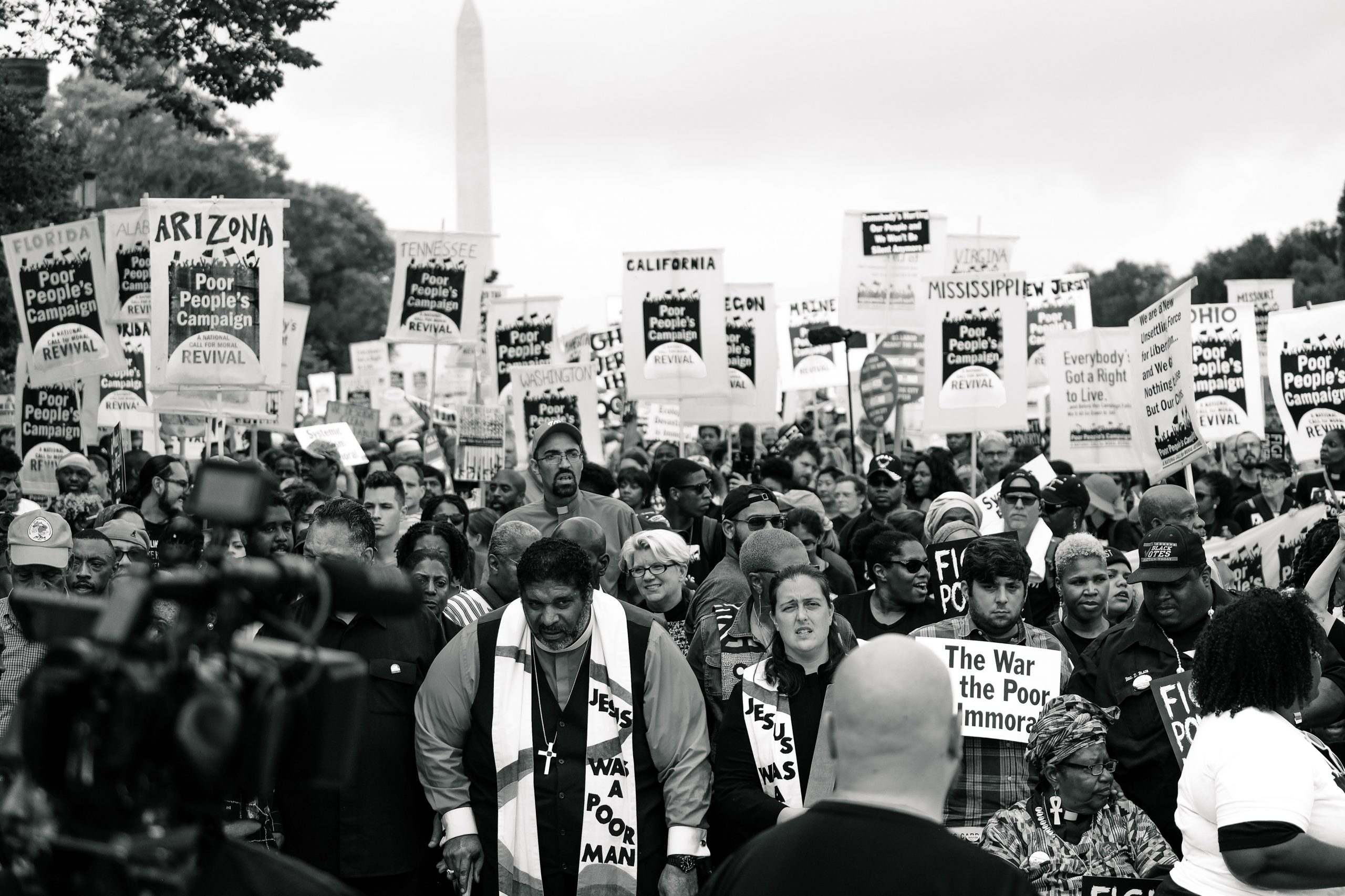
The Poor People’s Campaign rallies in Washington D.C., continuing the work undertaken 50 years earlier. Photo credit to Steve Pavey.

by Tomasz Falkowski

As upwards of ten million Texans faced a utilities crisis caused by record-low temperatures, Joe Biden signed the Paris Climate Agreement, reversing Trump’s abandonment of the same amid what was the most destructive wildfire season on record in California. While many applauded the retournement, others regarded the move as merely symbolic given the treaty’s shortcomings. These gestures of political theatre have typified Biden’s first months in office. It seems that peeling back the genteel veneer of a return to normal where “science is real…[and] kindness is everything” reveals an unwillingness to seriously consider the sweeping changes required this decade to avert global climate catastrophe. 

Biden’s embrace of the status quo is as disappointing as it was predictable. U.S. politicians serve primarily at the pleasure of America’s capitalist class rather than advocate for the common good of the populace and the planet we all inhabit. Although popular support is rising for bold climate action, the corporations disproportionately responsible for the majority of anthropogenic greenhouse gas emissions have wielded their economic power to stymie regulation and spread misinformation. Their noncompliance overshadows the individual actions we take to reduce our personal carbon footprints. 

Environmental destruction is not an unfortunate side-effect of mismanagement but an inherent manifestation of an economic system operating by design. Capitalism’s internal logic demands infinite growth, and the neoliberal tendency toward deregulation and privatization makes averting climate change in a capitalist context impossible. Most governments, however, remain undeterred and continue implementing watered-down, market-driven half-measures. Such “eco-capitalism” provides the illusion of restraining capitalism’s destructive tendencies without confronting any of its structural failures. 

Proponents argue this approach is more reasonable than severe regulation because it requires only limited economic changes. Cultural hegemony—a process by which those in power shape social norms and values to impose a particular mode of production—presents capitalism as the most practical and effective way to address the problems we face rather than one of their ultimate causes. Even worse, it is painted as inevitable, as opposed to the human construct that it is. Like fish unaware they swim in water, capitalism has become a hyperobject that pervades our lives and subsumes threats to its primacy. Its boundlessness seems to exceed our capacity to conceptualize what it is and precludes us from reasonably considering alterations to its fundamental structures. For many, it seems easier to imagine a future devoid of either a functioning ecology or human society than one free of capitalism. 

However, the milquetoast incrementalism of eco-capitalist reforms also renders them impotent. The old adage, “the master’s tools will never dismantle the master’s house,” resonates with the inability of moderate measures to avert the present crisis. Eco-capitalism’s primary directive remains maximizing profits for shareholders, which fundamentally conflicts with our finite world’s limits to growth. Presuming that small tweaks to the existing system will suffice only serves to overestimate their potential impact and underestimate the scale of the problem they purport to address. At present, we face ecological tipping points that are unavoidable without a wholesale shift in our society’s use and sourcing of energy—a solution that is utterly incompatible with market mechanisms. 

No wonder then that, in devouring ever more of Earth’s gifts to fuel the engines of economic growth, the Moloch of globalized capitalism has helped create the conditions to unleash and exacerbate pandemics. Governments have concentrated on regulating wet markets and providing public money to fund private ventures’ vaccine and testing development. By contrast, calls from the scientific community to curb deforestation and biodiversity loss, and to regulate transnational, monocultural, industrial agriculture in the hopes of preventing the emergence of zoonotic diseases have largely gone unheeded. In March 2020, however, the consequences of avoiding these vital changes became apparent.

It’s life, that’s all

In the wake of COVID-19, immutable givens seemed to waver. In the early days of the pandemic, our expectations had to adjust to a sobering new reality. Lockdowns limited travel and social encounters. Teachers, children, and their parents adapted to online learning. Non-essential businesses closed. Millions were furloughed or lost their jobs. Even seemingly inexorable institutions faltered. Contrasting the very tangible dangers of a global pandemic with the illusory exigence and false promises of capitalism encouraged us to let the gears of economic engines grind to a halt to protect ourselves and others from the virus. 

Like all crises, the pandemic has been revelatory, exacerbating pre-existing cracks in the fragile systems we had accidentally overlooked or willfully ignored. COVID-19 has illuminated the inefficiency and indignity of for-profit healthcare; the precarity of pauperized social safety nets; the suicidality of environmental management that values profitability over sustainability; the indecency of wasteful food systems amid commonplace hunger; the cruel inequity of social systems that value some lives over others by race, class, gender, and sexual identity; the villainy of economic systems that facilitate 1% of the world’s population to acquire almost 50% of humanity’s wealth and produce 15% of global carbon emissions. 

Initially, this international health emergency appeared to be the catalyst for implementing popular changes to the entrenched status quo. The pandemic had already shifted our lives in ways that were previously unimaginable. If ever there was an opportunity to begin living a prefigurative future, this was it. Death’s caprices jolted us from our slumber, reminding us that the question of being and not-being is far more fickle than we would like to imagine. Whiplashed by the change of pace after so many years of doing more and moving faster, some deeply ingrained inertia turned us toward the steadying constancy of what we needed most: the comforting embrace of the human and ecological communities upon which we depend. 

After rousing us, however, the pandemic has begun to wear us down. The preposterous has become mundane. The political, economic, and social ramifications of the pandemic will continue even as the pandemic eventually winds down. Eager to remain dominant, big businesses have lobbied for generous corporate bailouts. Faustian governments have devoted $12 trillion to stimulate economies, yet they have not allocated a fraction of that to redesign low-carbon energy systems. Betrayed by austerity-tattered social safety nets and forced to choose between their health and livelihoods, millions of people have been coerced to return to work. 

Even so, many employers have not provided adequate personal protective equipment, healthcare, or paid sick leave for workers, while others have rejected COVID-related benefit claims. Working from home has converted every waking hour into potential work time, allowing employers to appropriate even more labor value from their employees. Disjointed from any pretext of realism, the stock market is once again operating in the black. Health insurance companies have raked in record profits, and as more middle- and lower-income families teeter on bankruptcy or eviction, the wealthiest individuals’ net worth continues its unfettered rise. Even as farmers dumped food that they could not sell while store shelves lay bare, suggestions to promote local foodways and curb the waste of globalized food systems have been disparaged as “the worst possible response.” Beguiled by a return to some semblance of normalcy, we show signs of once again willing to believe that capitalism, despite its flaws, is actually our best defense. After all we have gone through, the new normal does not appear all that different from the old. 

Perhaps we can be forgiven for capitulating to capitalism’s sweet nothings. Capitalism’s legacy is sold as one of freedom, wealth and comfort, while its less glamorous products, like rampant poverty, inequality and environmental destruction, are conveniently ignored. Critiques of capitalism are repressed or misrepresented as totalitarian, regimented, and austere, despite the many alternatives to capitalism which are not inherently authoritarian. After being hit incessantly over the head with this false dilemma in our schools, advertising, news, and entertainment, a collective cultural amnesia has developed that prevents us from imagining different futures. By finding new narratives into which many stories fit, we can expand our perspective of the possible.

Invincible dreamers

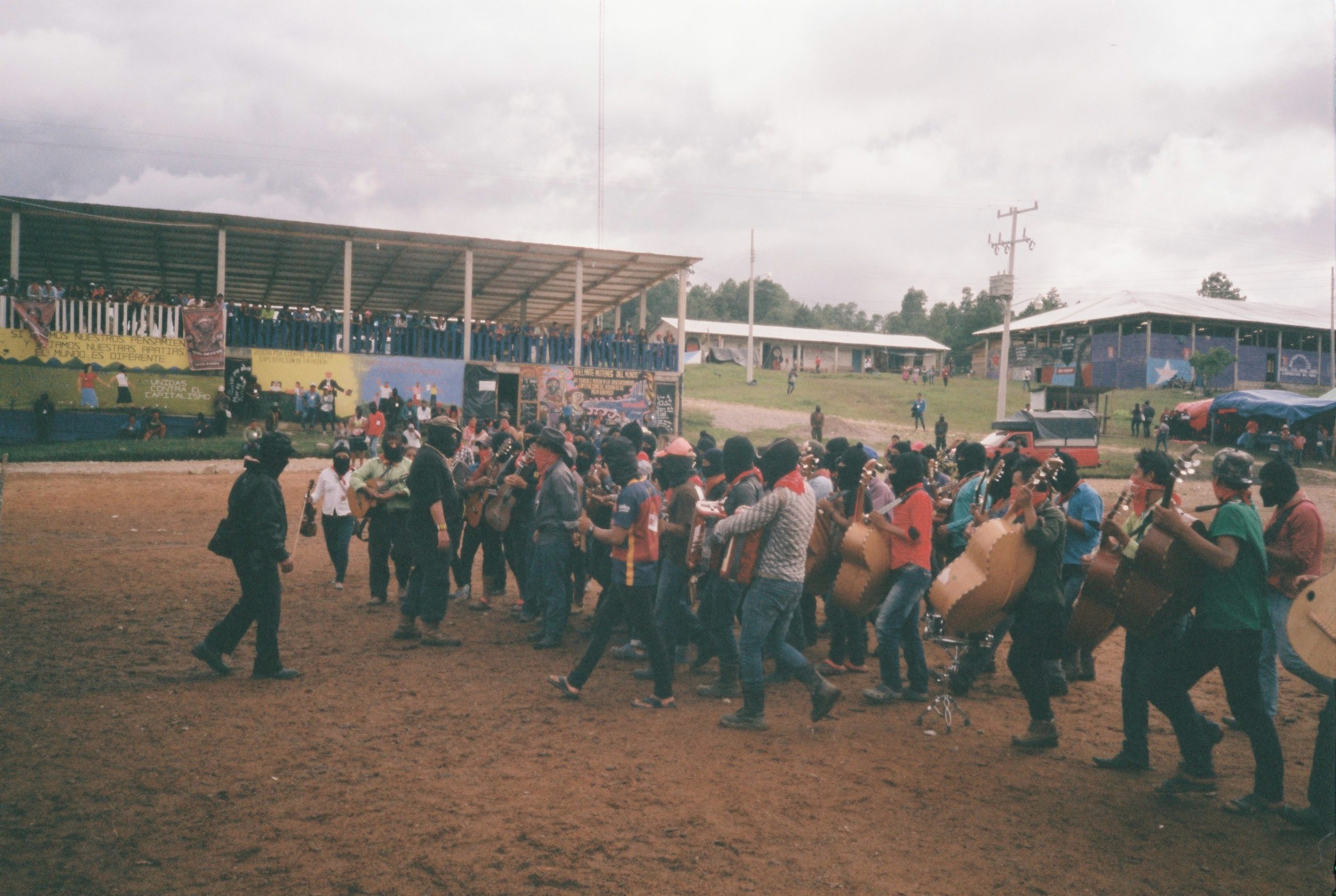
The Zapatistas of Chiapas, Mexico have been cultivating a truly “new normal” for the better part of three decades. Their philosophy of Neozapatismo is rooted in the traditional lifeways of Indigenous Maya peoples, interwoven with anarchism and Marxism. It is a modern manifestation of the resilience they have honed over centuries of colonization, dispossession, and marginalization. For the Zapatistas, socioecological crises have never been some vague, future threat, but a present, brutal reality. Climate change and neoliberal markets have undermined the viability of the agricultural systems they adapted over centuries. Megaprojects funded by international capital like hydroelectric dams and intercity railways threaten to forcibly displace dozens of communities and devastate the ecosystems upon which they depend. Lacking the political or financial means to defend their communal interests thousands of Maya—pushed to the brink—occupied government buildings, freed Indigenous prisoners, and destroyed land records, declaring “Ya basta!” (Enough!) on the day NAFTA went into force in 1994. Systemic change, sowed and reaped by their own hands, was imperative for safeguarding their culture and supporting both their human and non-human neighbors alike.

Zapatistas celebrating in one of their caracoles. Photo credit to Dawson Weehunt.

Hagiography is not my intention. Like all messengers, the Zapatistas are imperfect. Inequality and poverty are still rampant. Some compañer@s are content to accept government aid, reflecting an economic pragmatism that tempers their political idealism. Smallholder farmers have contributed to deforestation, though less than other forms of land management, including large-scale agriculture. Despite attempts at participatory democracy, patriarchal structures prove difficult to dismantle. These contradictions do not necessarily belie the value of this vanguard’s unique vision for “a revolution that makes possible the Revolution.” The Zapatistas’ struggle against the power of global capital still serves as a vital and vitalizing inspiration for creating parallel lifeways in the cracks and along the margins. 

From the onset of the pandemic, the Zapatistas distributed thousands of reusable masks, initiated a program for sewing additional face coverings, and provided hygiene products among their communities. Meanwhile, many in the U.S. hoarded basic household items, betraying a lack of trust either in our communities’ capacity for cooperation or our government’s willingness to serve its citizens. Then, when U.S. states rushed to open commercial spaces and beckoned their citizens to return to business as more-or-less usual, the Zapatistas instead closed their caracoles—centers of resistance and rebellion that organize collectivist programs—and continue to avoid urban areas as much as possible. Furthermore, a common practice amongst Zapatistas has been to quarantine anyone who has had contact with sick individuals. Such people are ensured food and resources are delivered to them so that the farms and forests upon which all depend are not compromised. By contrast, workers throughout the U.S. often face the Sophie’s choice of defaulting on bills or risking infection. 

Despite a lack of government resources or support, such as access to any testing whatsoever, as few as 12 compañer@s died of symptoms related to COVID-19 during the first six months of the pandemic. Ultimately, the Zapatistas attribute their rapid response and caregiving capacity not to any medical technology, but to their unity. In refusing to be divided (at a healthy distance), they are coping with the pandemic not as individuals but as a collective

The Neozapatismo maxims of “para todos todo, para nosotros nada [everything for everyone, nothing for ourselves]” and “un mundo donde quepan muchos mundos [a world where many worlds fit]” also infuse the Zapatistas’ environmental philosophy and practices. Ever since the initial uprising, direct actions have been coordinated to highlight how top-down economic development—even when it is greenwashed as “sustainable”—invariably leads to environmental devastation. Any attempts to promote “development” or address ecological degradation must be framed in opposition to the annihilatory regimes of capitalism, racism, patriarchy, militarism, and colonialism. Maya do not consider themselves parasitic or passive towards nature, but as an enlivening, life-giving force. Fostering ecological growth and diversity through regular and respectful interactions, including use and ceremony, they defend against attempts to privatize their communal lands, maintain traditional agroecosystems honed over centuries of sustainable management, and cultivate culturally-important food and medicinal plants in cooperative tree nurseries for grassroots restoration efforts. 

Such “glocal” responses highlight one of the paradoxes at the heart of Zapatismo. On the one hand, Zapatista communities celebrate their autonomy and self-sufficiency, ensuring they can remain independent from the hegemony of globalized economies and western culture. However, they also acknowledge a direct dependency on networks of immediate relationships in the human and non-human world. Their revolution is largely centered on building community, well aware that their social cohesion and rich cultural knowledge compensates for what they lack in political or financial capital. 

By contrast, environmental discourse in the U.S. has historically been dominated by a mild misanthropy, articulated in Pogo’s aphorism: “We have met the enemy, and he is us.” We attempt to buffer the environment from humans’ polluting influence by separating the two. E.O. Wilson’s Half-Earth proposal goes so far as to suggest that half the planet be preserved—devoid of humans. Of course, the human species bears a large ecological footprint, and conserving ecological integrity is laudable, but environmental destruction is more a function of a perverse economic system controlled by and benefiting a particular subset of humanity than fundamental human nature writ large. Laying the blame for environmental destruction at the feet of humankind as one unified Anthropos absolves the true culprits and delays the actions necessary to address its ultimate drivers. 

Perhaps the greatest lesson we may learn from the Maya is how to become, as Robin Kimmerer suggests, “Indigenous to place.” To address the epic crises at hand, we need to move beyond simplistic human-nature binaries. Restoring the land requires us to restore our relationship to it, as evidenced by the intimate connection between exposure to nature and stewardship. Sustainability is less a technical question of properly controlling natural processes and resources; rather, it is a collective social responsibility of controlling ourselves. Sustainability is not merely a question of how much we consume; it is about the ways in which we contribute. We must break the cycle of separation, objectification, and exploitation to transcend the false dichotomy that sets human culture at odds with nature. Instead, we must allow our human cultures to be reflections of nature—a part of rather than apart from. When we accept the earth’s gifts with gratitude and reciprocate with our own, we shape the land into cultural landscapes that reflect our nature of restraint and generosity. 

Walking together

Re-learning how to participate as equal members in the gossamer web of life is no easy task. Thankfully, many examples have endured and may show us how to restore these relationships in full. These teachers range from Indigenous communities around the world; to fishers, foresters and farmers who have learned to work with the land, not just on it; as well as the plants and animals with whom we share this planet. 

A primary obstacle hampering many contemporary social movements in the U.S. is their focus on individuals and personal responsibility. While the likes of Rachel Carson, Aldo Leopold, Robert Marshall, and John Muir certainly played a role in catalyzing enviornonmental movements in their times, the nigh-messianic legends enshrouding them too often efface the relationships of everyday people essential to effecting change. Absent mutual struggle, any individual (prophetic though they may be) is an easily-silenced voice in the wilderness.     

Furthermore, while small, personal acts can be noble when facing the seemingly Sisyphean challenge that is climate change, we must also recognize their impact is limited at best. The idea that individual consumer choices can manifest meaningful social change is informed by institutions who would prefer to maintain the present state of affairs (the plastic industry’s ardent support for ineffective recycling programs being a textbook example). Stark inequality alone undermines any consumer power we could wield against financial elites. Buying into the notion that our individual consumer choices can advance social justice merely permits certain businesses a greenwashed façade. These amount to nothing more than veneers of social awareness when, in fact, the companies remain complicit in and benefit from systems of oppression. The scope of capitalism’s institutionalized greed demands a coordinated response at a societal level. Collective action and communal organization are the answer.

The histories of the New Deal and Great Society programs; the Fair Labor Standards and National Labor Relations Acts; the Civil and Voting Rights Acts; and the Clean Water, Clean Air, and Endangered Species Protection Acts have demonstrated that necessary, sweeping changes do not manifest as a result of individual, privately-funded crusades. Progressive legislation is the product of diverse coalitions of environmental, labor, civil rights, and faith organizations sustaining significant pressure on the local and federal governments. Our survival is dependent on community; our strength is forged by our relationships; and our success is predicated on balancing sovereignty with solidarity. 

In the U.S., the Poor People’s Campaign epitomizes these principles. Continuing the work that the Southern Christian Leadership Conference was undertaking before Dr. Martin Luther King Jr.’s assassination, the Campaign is uniting a diverse coalition of disenfranchised communities to “confront the interlocking evils of systemic racism, poverty, ecological devastation, militarism and the war economy, and the distorted moral narrative of religious nationalism.” Noting the immorality of the want of so many amid the abundance for so few, and reflecting the intersectional nature of the ecological and social crises we face, their demands for change are broad and deep, ultimately aiming to restore human dignity.

Foregoing the peculiarly American mythology of rugged individualism, the Campaign reminds us that we are braver and more hopeful when we join together than when we are divided and alone. Our society is only as successful as the least among us, and if we are to rise to meet the challenges we face, then we must do so together. In restoring our faith in the multiplicative power of we, the illusory division between us falls away and reveals, as King so eloquently put it, our “inescapable network of mutuality, tied in a single garment of destiny.”

The 2020 U.S. presidential election reflected a demand for change. However, given the choice between a “neoliberal disaster and a neofascist catastrophe,” our efforts must continue. Participating in protests and boycotts promotes solidarity, but the real challenge is transforming that collective power to subvert capitalism in our daily lives. To cultivate a community garden is to foster food sovereignty and develop social networks. Working with locally-organized food distribution organizations like Food Not Bombs rescues food waste and grants dignity to hungry neighbors in a heathy, fun, and communal manner. Joining or facilitating labor unions helps reduce the gender pay gap, ensure workplace safety, and fight for worker benefits. Frequenting and supporting your local library encourages community cohesion and educational equity. Helping grassroots organizations that promote public investment in mass transit improves air quality and enhances equal access to transportation. 

One year into the pandemic and counting, many of us are attempting at last to make plans for an all too uncertain future. Joe Biden’s administration has named climate change a national security threat and revised national emissions reduction goals. At present, these are toothless and insufficient to avert the 1.5°C of warming expected in the next decade. While the National Security Council sets its aim at climate change, ignoring its own central role in environmental and humanitarian catastrophe, the Zapatistas have set sail to share in the struggles with compañer@s in Europe, and the Poor People’s Campaign continues to mobilize citizen blockades of oil pipelines and virtual mass assemblies of low-wage workers. Which stories will we help write?   

Every day, we choose how we face the coupled menace of climate change and COVID-19. Capital’s champions have rallied to argue that systemic change can wait for a more convenient time after this immediate emergency. But, as James Baldwin asked, “How much time do you want for yourprogress’?” Indeed, how tragic would it be if the world as we know it remained on its slouching course toward a broken normal in the wake of a global event so often described in eschatological terms? Considering the socioeconomic and ecological crises ahead, none of us, least of all the most marginalized, can afford to wait. 

Tomasz Falkowski is an assistant professor in the Department of Forestry at New Mexico Highlands University. Over the past decade, he has collaborated with milperos in Mexico to research traditional agroforestry management and how it could facilitate socioecological restoration. He is also investigating forest restoration in New Mexico and adaptive management of community gardens. When not working, Tomasz escapes to the mountains and cultivates a garden with his partner.

April readings

Source: Grist / Amelia Bates

Once a month, we put together a list of stories we’ve been reading: news you might’ve missed or crucial conversations going on around the web. We focus on environmental justice, radical municipalism, new politics, political theory, and resources for action and education.

We try to include articles that have been published recently but will last, that are relatively light and inspiring, and are from corners of the web that don’t always get the light of day. This will also be a space to keep you up to date with news about what’s happening at Uneven Earth.

This month’s list is a little shorter than usual, but maybe that’s not a bad thing! In April, we read stories about India’s Covid catastrophe, the dangers of the concept of net zero, toxic USA, an Aboriginal family beating back a fossil fuel conglomerate, the death and post-Covid comeback of “third spaces”, as well as a fact-check of the new Netflix documentary Seaspiracy and a general critique of nature documentaries, to name a few. There’s also been quite a bit of discussion around Malmology — a very serious term we coined to describe Andreas Malm’s work. And, as you probably know by now, degrowth, global environmental justice struggles, radical municipalism, and new politics are recurring themes in our readings.

A small note that the articles linked in this newsletter do not represent the views of Uneven Earth. When reading, please keep in mind that we don’t have capacity to do further research on the authors or publishers!


Uneven Earth updates

We hit 5k followers on Twitter this month — join the party!

Is green growth happening? | The answer is no. Decoupling will not be enough to ensure ecological sustainability without a downscaling of production and consumption.

The commons | The commons opposes and transcends the logic of capitalism by building relations based on cooperation, solidarity, mutualism and direct democracy

Review of Resource Radicals: From Petro-Nationalism to Post-Extractivism in Ecuador by Thea Riofrancos | Resource Radicals marks an important contribution to burgeoning literature on resource politics and democratic practice

Well diggers tackling water woes in a megacity: The case of Bangalore, India | The ever-fast growing metropolis Bangalore is running out of groundwater. Yet traditional water practices might be key to a sustainable use of the blue gold below us.


Top 5 articles to read

Did climate change cause societies to collapse? New research upends the old story.

Climate scientists: concept of net zero is a dangerous trap

How an Aboriginal family beat back a fossil fuel conglomerate

How value weaponises the machine. In Breaking Things at Work, Gavin Mueller reminds us that the new antagonism between consumer and platform over data capture is not unlike the struggle between worker and capitalist over wages and the working day.

Arundhati Roy on India’s Covid catastrophe: ‘We are witnessing a crime against humanity’ 


News you might’ve missed

Oxford/AstraZeneca Covid vaccine research ‘was 97% publicly funded’

Rich countries are refusing to waive the rights on Covid vaccines as global cases hit record levels

Environment protest being criminalised around world, say experts 

A top U.S. seller of carbon offsets starts investigating its own projects

French lawmakers approve a ban on short domestic flights 


Toxic USA

‘No community should suffer this’: Florida’s toxic breach was decades in the making

The toxic legacy of the US military in the Pacific

Nuclear colonialism and the Marshall Islands


Global environmental justice struggles

Georgia: guardians of the Rioni Valley face off the dams

Land grabs and other destructive environmental practices in Cambodia test the International Criminal Court

Attacks on forest-dependent communities in Indonesia and resistance stories

Canada: hummingbirds succeed in halting controversial pipeline construction 


Where we’re at: analysis

SILENCE = DEATH, ACTION = LIFE: New relevance of HIV/AIDS organizing in COVID pandemic times

The rise and fall of multilateralism

Revenge of the plans. Why do we keep reviving technocratic climate politics when it has consistently failed?

Digital colonialism: the evolution of American empire 

Joe Biden’s new Climate Pledge isn’t fair or ambitious 


Just think about it…

Deepfake satellite imagery poses a not-so-distant threat, warn geographers

Why bitcoin is bad for the environment 

Learning a new language can help us escape climate catastrophe. Many Indigenous languages have been forcefully wiped out by white people. Turns out, they’re some of our main hopes for beating the climate crisis.

The problem with nature documentaries

What Netflix’s Seaspiracy gets wrong about fishing, explained by a marine biologist

The 7 reasons why nuclear energy is not the answer to solve climate change

To save the Earth, dismantle individuality


Malmology

The kaleidoscope of catastrophe – On the clarities and blind spots of Andreas Malm

Can sabotage stop climate change?

How to blow up a movement: Andreas Malm’s new book dreams of sabotage but ignores consequences

Andreas Malm’s Corona, Climate, Chronic Emergency


Degrowth

Why Malthus’s gospel of growth was, and still is, wrong

Beyond the growth imperative 

Degrowth in demand. Lexie Smith and Jamie Tyberg on degrowth, decolonization, and agriculture.

On sacrifice


New politics

From fossil capitalism to green democracy

Book review: Enlightenment and ecology: The legacy of Murray Bookchin in the 21st century

A youth revolt is under way in South Korea

Farmers are using their stimmys to grow free food for their communities


Sci-fi

Born to rewild: Jeff VanderMeer on what it means to restore your own little part of the world


Cities and radical municipalism

The death and post-Covid rebirth of ‘third places’. “Third spaces” like coffeeshops, gyms and libraries are critical for building community ties and boosting social cohesion. What happens when they almost disappear for more than a year?


Resources

Gender bias in Academe: An annotated bibliography of important recent studies


Want to receive this as a newsletter in your inbox? Subscribe here.